
Paramount Pictures · 1947
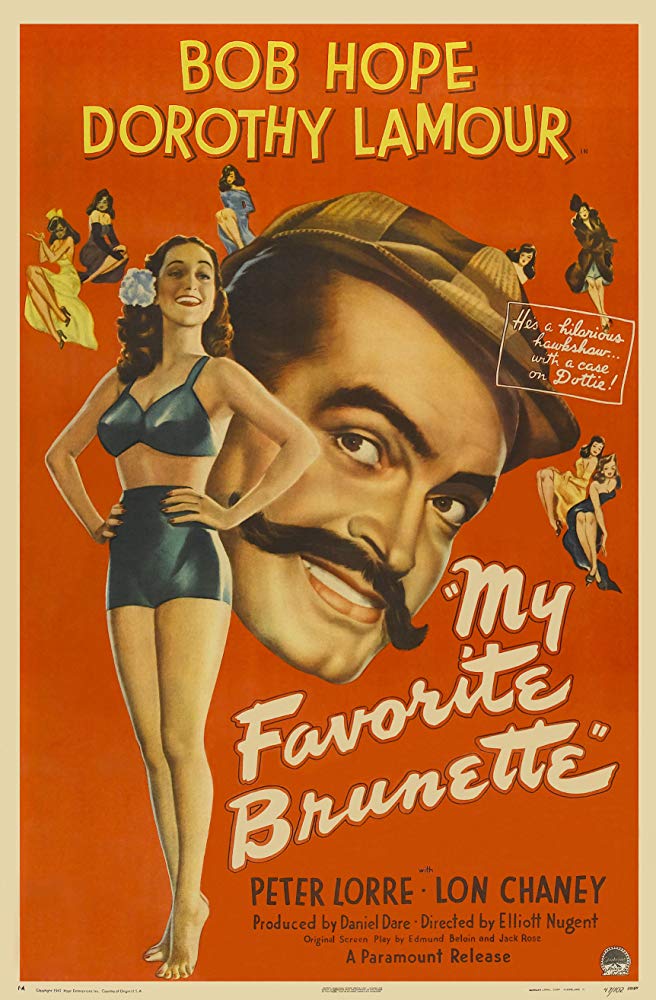
My Favorite Brunette
A hapless baby photographer. A mysterious woman. A body on the floor.
The Story
Ronnie Jackson has the wrong job. A mild-mannered baby photographer working out of a San Francisco office building, he dreams of being a hard-boiled private detective — the kind who gets the girl and cracks the case. When his neighbor, genuine gumshoe Sam McCloud, steps out on business, Ronnie takes over his office.
That's when Carlotta Montay walks in. Beautiful, terrified, and very much a brunette, she mistakes Ronnie for a real detective and begs him to help find her missing uncle — a geologist whose secret mineral survey has made him a target. Against every instinct for self-preservation, Ronnie agrees.
What follows is a cascade of hired thugs, double-crosses, shadowy asylum corridors, and at least one body Ronnie absolutely did not put there. By the time the credits roll, he's on death row at San Quentin — telling the whole story to a pack of reporters the night before his execution, praying someone believes him.
"I was a big shot for exactly three days. After that, the law had a different name for me." — Ronnie Jackson, My Favorite Brunette
Cast
Production
The film was produced by Daniel Dare and shot entirely on the Paramount lot in Hollywood. Cinematographer Lionel Lindon — who would later win an Academy Award for Around the World in 80 Days — brought genuine noir atmosphere to the picture, leaning into high-contrast shadows and rain-slicked interiors that made the comedy land harder against the genre's dark trappings.
The casting of Peter Lorre and Lon Chaney Jr. was entirely deliberate. Both men were fixtures of Hollywood's horror and thriller landscape — Lorre from M and Casablanca, Chaney from the Universal monster pictures — and seeing them play straight menace against Hope's mugging cowardice gave the film an additional layer of knowing absurdity that audiences recognized immediately.
Bing Crosby, Hope's longtime collaborator and on-screen rival from the Road to... series, appears in a brief but memorable cameo in the final scene — a wink to audiences who knew the pair well.
The Noir Era
By 1947, film noir had fully crystallized as a Hollywood mode. Double Indemnity (1944), The Killers (1946), and The Big Sleep (1946) had established the grammar: the voiceover confession, the femme fatale, the cynical detective, the corrupt institution lurking behind a respectable façade. Audiences knew the conventions well enough that a parody could work — but only if it played them straight enough to be recognizable.
That's what My Favorite Brunette does. It doesn't mock noir so much as inhabit it from the wrong perspective: instead of a competent loner navigating a corrupt world, we get an incompetent optimist who stumbles through the same world and somehow survives. The joke is never that noir is ridiculous. The joke is that Ronnie Jackson is.